



This is the first in a series.
Every September, the world’s most powerful government leaders gather at the United Nations General Assembly to deliver speeches that remind us of bad third-act exposition from a movie no one really wants to watch.
From watching Mahmoud Ahmadinejad’s motorcade blaze down Riverside Drive (while oddly waving with windows open) to having to show my driver’s license to enter the Murray Hill street I shared with the Cuban Embassy, September in the city meant to me a front-row seat to world leaders and diplomats driving their motorcades to and fro in order to perform feats of political acrobatics at the UN podium while making me late for everything.
But no matter how rehearsed those speeches felt, we used to believe the people at the podium held the fate of the world in their hands. Today, in an era dominated by oligarchs and techno-fascists, the speechmakers at the UN feel increasingly like supporting players in a drama directed elsewhere, behind-the-scenes, in a place we never see.
The theme for this year’s General Assembly is ”Restoring Trust, Managing Transformation: A United Nations That Delivers for All.” (If only naming a conference could make it so.) As usual, the agenda targets climate, global health, and emerging technologies. And as usual, the UN will have little progress to celebrate.
Much of that failure rests on the missing leadership of the United States. While our Great Plains sit atop what many call the Saudi Arabia of wind energy, policy swings and rollbacks have redirected massive investments back toward fossil fuels. Meanwhile, the real-world consequences play out in small, silent ways: I can no longer grow green beans in my garden. The past few summers have been too hot for the vines to flower, a process that requires nighttime temperatures between 60°F and 65°F. Can someone explain to my stubborn bean plants that renewable energy didn’t fit the political narrative and that windmills are in the view of some nationally strategic golf courses in Scotland, so they’ll just have to adapt?
Four Decades Ago
We have known the physics for nearly four decades and it was the United States who alerted the world to climate change. Other nations certainly had their own science but they did not have our NASA or our national treasure, scientist James Hansen, schooled in physics and astronomy. He started out working to understand the atmosphere of Venus and wound up understanding our the atmosphere of our Earth even better and how our activity was warming it. In 1988, long before my green beans stopped producing, Hansen delivered his landmark testimony to Congress:
“….Global warming is now large enough that we can ascribe with a high degree of confidence a cause and effect relationship to the greenhouse effect….Our computer climate simulations indicate that the greenhouse effect is already large enough to begin to effect the probability of extreme events such as summer heat waves.”
Business and government barely flinched.
The Inconvenient Climate Narrative
Eighteen years later, Al Gore stepped onto a scissor lift in An Inconvenient Truth to point at a rising chart, attempting to translate Hansen’s physics into popular culture. But while Gore put climate on the map, he also accidentally codified America’s cultural divide on the issue and created the blueprint for two decades of terrible climate storytelling.
The failure began with the title itself: An Inconvenient Truth. First, the American public doesn’t do irony. Much of the public, whether having actually seen his presentation or not, took his call to action purely as a lecture. As a result, our survival was framed as a chore, a tax, or a moral hygiene test you pass by feeling bad. Worse still was that initial article: “An”, not “The” Truth. The titling invited the public to treat facts as a matter of personal preference. It makes the audience think this is just one truth of many and not absolutely singular and real. And if multiple truths doesn’t describe the problem of our times, I don’t know what does.
Of course, many in Hollywood understand irony and understood the import of what humanity was doing (and gave the film an Oscar). But the filmmaking community made more mostly dry documentaries or pushed climate change into abstract, post-apocalyptic disaster porn (The Day After Tomorrow, Snowpiercer).
Branding Lessons and Annoying Killjoys
Those wanting to tell the climate story with real impact should take a lesson in branding from Donald Trump. Though his recent renaming efforts of the Gulf of America and Lake America have produced clunkers, whatever one thinks of his rhetoric, Trump intuitively understands the lizard-brain resonance of language and possesses an instinctual understanding of the unconscious. He gets the sticky, visceral power of a name.
Gore’s framing lacked that instinct. What if Gore’s project had been called “The Apocalyptic Truth” or “The Man-Made Truth” or simply “the Truth”? No irony, no punches pulled, just powerful facts. (I also would approve the spectacle-like sound of “Death Climate.”)
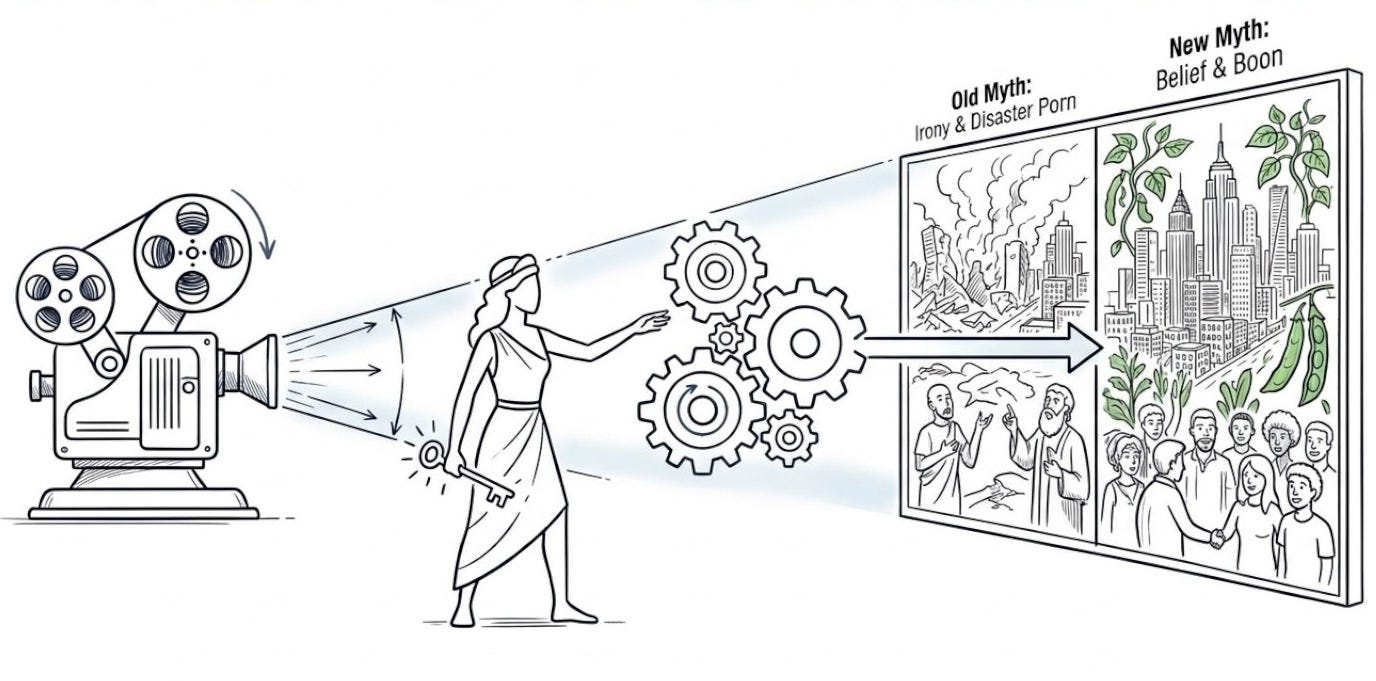
Following Gore, a generation of storytellers unwittingly took on the myth of Cassandra, the Trojan princess and priestess who was gifted the power of true prophecy but cursed to be dismissed, mocked, and never believed. For those of us who passed high school physics, we understand global warming. We don’t see Cassandra in the climate story. We see the mocking mob about to suffer the disaster and resign ourselves to their fate. But what if we refuse to accept that fate? How do we tell the truth in story and documentary to those who are not emotionally moved by the power of physics?
Adam McKay tried to tackle the Cassandra dynamic head-on with satire in Don’t Look Up but his Cassandras met the same fate as the mythic original: Leonardo DiCaprio and Jennifer Lawrence’s characters screamed into the void, failed to convince media and political figures to take action and died in the end along with humanity.
Re-engineering the Cassandra Archetype
The problem with most modern climate narratives is that they treat denial as mere stupidity. But the real inconvenient truth is that re-engineering a myth is hard. If we want stories that move people who are not moved by facts alone, we have to invent a new myth for Cassandra. It must be both believable in the world of its story and resonate emotionally.
A successful re-engineer should entertain these three elements:
Focus on the Psychology of Denial: Shift the tension from the warning itself to the protective, deeply human reasons people invent to deny reality and the protective purpose denial serves.
Make Cassandra an Active Protagonist: Stop writing her as a desperate, annoying killjoy. Make her an active protagonist navigating a world built on rationalized avoidance—a psychological thriller hero who offers a way through.
Replace the Doom-Loop with Conflict: Repackage her knowledge not as an inescapable curse but as the magic elixir and holy grail. Allow her to deliver her payload boon in the end (whether she is sacrificed herself or not is optional.)
Above all, we must abandon the elements of disaster porn in which there is spectacle without agency that gives audiences an adrenaline rush before returning them to business as usual.
Beyond Psychics and Physics
None of us lose all our child-like beliefs. Everyone, even our most powerful oligarchs, is susceptible to story. We understand our world through them and make our identities from them.
For the science-literate crowd, the physics of climate are clear. But for everyone else, the story must be retold in emotionally resonant, developmental stages. There are specific audiences who desperately need a better myth: Conservative Populists, Christian Nationalists, End-Times Fascists/Accelerationists, and the Manosphere.
Climate change is a choice and so is the story we tell about it.
In Part 2, I will detail the elements to construct a humanity-saving narrative tailored specifically for these audiences—and, in turn, for the rest of us.


